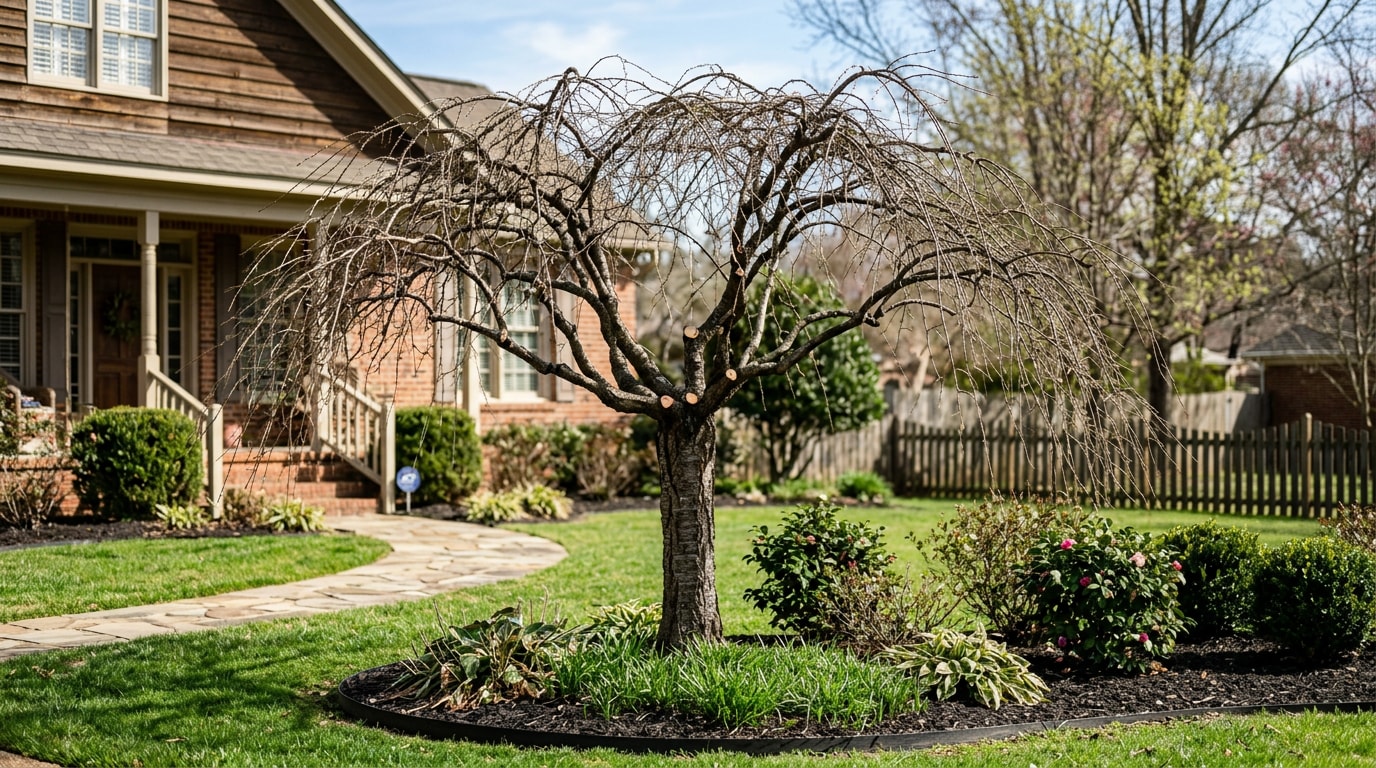
Pruning a weeping cherry tree in Richland, MS comes down to three things: knowing whether your tree is grafted, hitting the dormant-season window, and making clean cuts that respect the branch collar. Get any one of those wrong and you either sacrifice next spring's blooms or trigger ugly upright regrowth that ruins the cascade for years. Here's the full process, built around what actually grows in central Mississippi yards.
Is My Weeping Cherry Grafted?
Look at the trunk about four to six feet off the ground for a visible knot, bulge, or scar line where the bark texture changes. That's the graft union. Nurseries typically build weeping cherries by grafting a cascading top onto an upright rootstock trunk around this height so the canopy forms a neat umbrella shape at head height instead of a shrub weeping from the ground.
If you see that scar, your tree is grafted onto rootstock rather than naturally weeping. Most weeping cherries sold at Richland-area nurseries and big-box garden centers are grafted Higan types, so check your trunk closely before you pick up the pruners. A few varieties grow weeping branches from their own roots, with no swelling and a trunk that flows smoothly into the canopy.
This distinction matters because grafted and naturally weeping trees get pruned differently later in this guide.

When to Prune a Weeping Cherry Tree in Richland, MS
Prune weeping cherry trees during the dormant season, after the leaves drop in late fall and before new buds swell in late winter. Never prune while the tree is flowering or fully leafed out; that stresses the tree and cuts into next year's bloom.
Richland sits in what the USDA now classifies as plant hardiness zone 8b. The U.S. Department of Agriculture released the 2023 USDA Plant Hardiness Zone Map that indicates much of Mississippi is now in zone 8b , a half-zone warmer than the 2012 map most homeowners still reference. That shift matters for pruning timing because it reflects genuinely milder winter lows, and mild winters can trick trees into early bud break.
Last-frost timing isn't uniform across the state. Timing of the last frost varies from late February on the Coast to late March or early April in north Mississippi , and you do not want to encourage your plants to flush out with new growth until the threat of frost has passed . Central Mississippi, including Richland and Rankin County, typically falls between those two windows, so waiting until late winter gives you a clearer read on branch structure while still avoiding a late freeze that could damage fresh cuts.
There's a practical reason to wait, too: it is also easier to see the true branch shape of a tree or shrub when it is dormant . For a current read on local frost dates before you schedule pruning day, check Mississippi State University Extension's pruning timing guidance.
Why Pruning Matters for Weeping Cherry Health
Pruning isn't just cosmetic. Removing dead or diseased wood stops decay from spreading, and thinning crowded branches improves airflow, which cuts down on the fungal problems that thrive in Mississippi's humidity.
Regular cuts also keep low branches from dragging on walkways and support fuller blooms the following spring. Skip pruning for a few years and you typically end up with tangled growth and fewer flowers.
Tools You'll Need
A clean, well-matched pruning kit protects the tree from unnecessary damage and makes the job faster.
- Bypass pruners for stems and branches under about 1 inch thick
- Loppers for branches between 1 and 2 inches thick
- A pruning saw or pole saw for anything over 2 inches or too high to reach safely from the ground
- Sturdy gloves and, if your tree is tall, a stable ladder
Always sanitize pruning tools with rubbing alcohol or a diluted bleach solution between cuts, especially when removing diseased wood, to avoid spreading pathogens from branch to branch. If you'd rather hand the job to a professional crew, our tree pruning services cover the Richland area and the rest of the metro.
How to Prune a Weeping Cherry Tree Step by Step
The right approach changes depending on whether your tree is grafted or natural, and whether it's young or already established. Match your tree to one of the four sections below.

Pruning a Grafted Weeping Cherry Tree
Start by trimming drooping branch tips so they hang no closer than about six inches from the ground. This keeps growth off the lawn and reduces disease risk from soil contact.
Next, scan the trunk just below the graft union for upright shoots. These grow straight up instead of weeping. Cut them off completely since they draw energy away from the graft and will never cascade.
Finally, work through the crown to thin the tangle of crossing, rubbing branches that naturally forms on grafted weeping cherries. Remove a few each year, rather than all at once, to keep the canopy open without shocking the tree.

Pruning a Natural (Ungrafted) Weeping Cherry Tree
Natural weeping cherries need a lighter touch. Trim ground-trailing branch tips for clearance, remove dead or diseased wood, and clear out branches that cross or rub.
The key difference from grafted pruning: leave upward-growing branches alone. On an ungrafted tree, those upright shoots are part of the natural growth habit and arch downward as they mature. Cutting them prematurely can disrupt the tree's weeping shape.
How to Trim Young or Small Weeping Cherry Trees
Young-tree pruning focuses on identifying a strong central leader, removing narrow or competing upright shoots near the top, and lightly shaping the canopy into an outward, umbrella-like form rather than making heavy cuts.
Training a young tree this way in its first few years sets the structure for decades of healthy growth. Avoid heavy pruning on trees under three years old; light, occasional shaping is enough while the root system establishes.
How to Trim Mature, Large Weeping Cherry Trees
Established trees need maintenance pruning rather than structural shaping. Remove dead, broken, or crossing branches first, then head back any overly long branches just above an outward-facing bud, and thin congested interior growth so light reaches the inner canopy.
If your mature weeping cherry needs a ladder or has heavy limbs over a walkway or roofline, it's worth calling in a professional rather than risking a fall. We prune weeping cherries like this every winter in yards across the Richland area, and the ones that get handled by a crew with the right rigging tend to keep their shape far longer than ones left to a homeowner on a step stool. Get a free estimate before you climb anything you're not comfortable with.
How to Make Proper Pruning Cuts on Weeping Cherry Branches
There are two main cut types to know, and mixing them up is one of the fastest ways to damage a weeping cherry's healing response.
| Cut Type | When to Use It | How to Make It | Risk If Done Wrong |
|---|---|---|---|
| Collar cut | Removing an entire branch | Cut just outside the branch collar, angled down and away so water sheds off the wound | Flush cuts remove the tree's defense tissue; stubs invite decay |
| Heading cut | Shortening a branch, not removing it | Cut at roughly 45 degrees just above an outward-facing bud | Cutting mid-internode (between buds) can cause dieback and misdirected regrowth |
Every branch has a swell at the base, where it meets the trunk of the tree. This is known as the branch collar. All pruning cuts should be made further away from the trunk than the collar. For branches over roughly two inches thick, ISA's three-cut pruning method prevents the branch from tearing bark down the trunk as it falls: an undercut first, a top cut a few inches further out to drop the weight, then a final finishing cut just outside the collar.
Cutting into the collar itself, or leaving a long stub past it, slows healing and invites decay, which is a bigger risk in Mississippi's humidity than in drier climates.
Watch for Reversion Below the Graft
Watch for shoots sprouting directly from the rootstock below the graft line. These can revert to the rootstock's non-weeping parent species, growing upright and vigorous instead of cascading. Left alone, reversion growth can eventually overpower the grafted weeping portion of the tree.
Remove these rootstock shoots as soon as you spot them, cutting flush to where they emerge from the trunk. Check again every few weeks during the growing season since reversion shoots grow fast and are easiest to remove while they're still small.
Common Pruning Mistakes to Avoid
The most common mistakes stack up fast if you're not watching for them.
- Overpruning removes too much live wood in one season, stressing the tree and triggering weak regrowth.
- Pruning at the wrong time, such as during Richland's active spring bloom window, sacrifices flowers and opens the tree to disease during our humid growing months.
- Flush cuts and stubs both slow wound healing, which is riskier here than in drier climates since humidity speeds fungal colonization of exposed wood.
- Topping is the most damaging mistake of all.
Topping trees can cause decay, weak branch attachments, and an increased likelihood of failure. On a weeping cherry specifically, it destroys the natural cascading form, and topping leads to numerous upright, weak branches that never weep properly again. Purdue Extension's guide on tree topping breaks down why this practice does long-term harm to any ornamental tree, weeping or not.
If your weeping cherry has already been topped or neglected for several years, it may need more than a weekend of pruning to recover safely. Browse our tree trimming and pruning projects to see examples of restorative work, or visit {{SITE_URL}} for our full range of tree services. For readers dealing with storm damage or stump removal on the same property, our Tree Removal and Stump Grinding Near Me in Richland, MS) guide covers what comes after a tree is beyond saving.
Residents outside Richland can also find local crews through our Richland, MS service area page.
FAQ
How do I prune a weeping cherry tree?
Identify whether the tree is grafted, then prune during the dormant winter season by trimming drooping tips, removing dead or crossing wood, and clearing upright shoots below the graft. See the step-by-step section above for the full process by tree type.
What are the most common mistakes when pruning a weeping cherry?
Overpruning, cutting during the growing season instead of dormancy, and making flush cuts or leaving stubs that slow healing. Topping the tree to control height is the most damaging mistake on weeping varieties.
Are weeping cherry trees usually grafted?
Yes. Most ornamental and weeping cherry trees sold at nurseries are grafted onto a different rootstock species, typically four to six feet up the trunk, to produce the umbrella-like weeping habit. Check the trunk for a visible graft scar to confirm.
Can I prune a weeping cherry tree to stop it from weeping?
No. The weeping form is genetic, not a result of pruning technique. Pruning can direct growth, such as thinning crowded branches or removing upright shoots, but it won't eliminate the cascading habit of a true weeping variety.
What is the lifespan of a weeping cherry tree?
Many ornamental weeping cherries live around 15 to 30 years with good care, though this varies by variety, site conditions, and pruning history. Consistent, correctly timed pruning supports better overall tree health.
How do you keep a weeping cherry tree small?
Light, regular tip trims during dormancy keep size in check far better than one aggressive cutback. Heading back a pendulous branch tends to make the regrowth stiffer and more upright, which works against the shape you're trying to keep.
Should I hire a professional to prune my weeping cherry tree?
If the tree requires a ladder, has limbs over a structure, or hasn't been pruned in several years, a professional crew reduces both the safety risk and the chance of a cut that damages the tree's shape long-term.